💰 Introduction
In our college capstone design project, our budget is too limited to keep paying ongoing AWS cloud costs.
However, our infrastructrue does not need to run 24/7.
Since the NAT Gateway incurs relatively high costs simply by begin provisioned, we decided to remove it during non-working hours.
This allows us to reduce unncessary expenses while keeping the envionment available when the team is actively working.
💡 Strategy
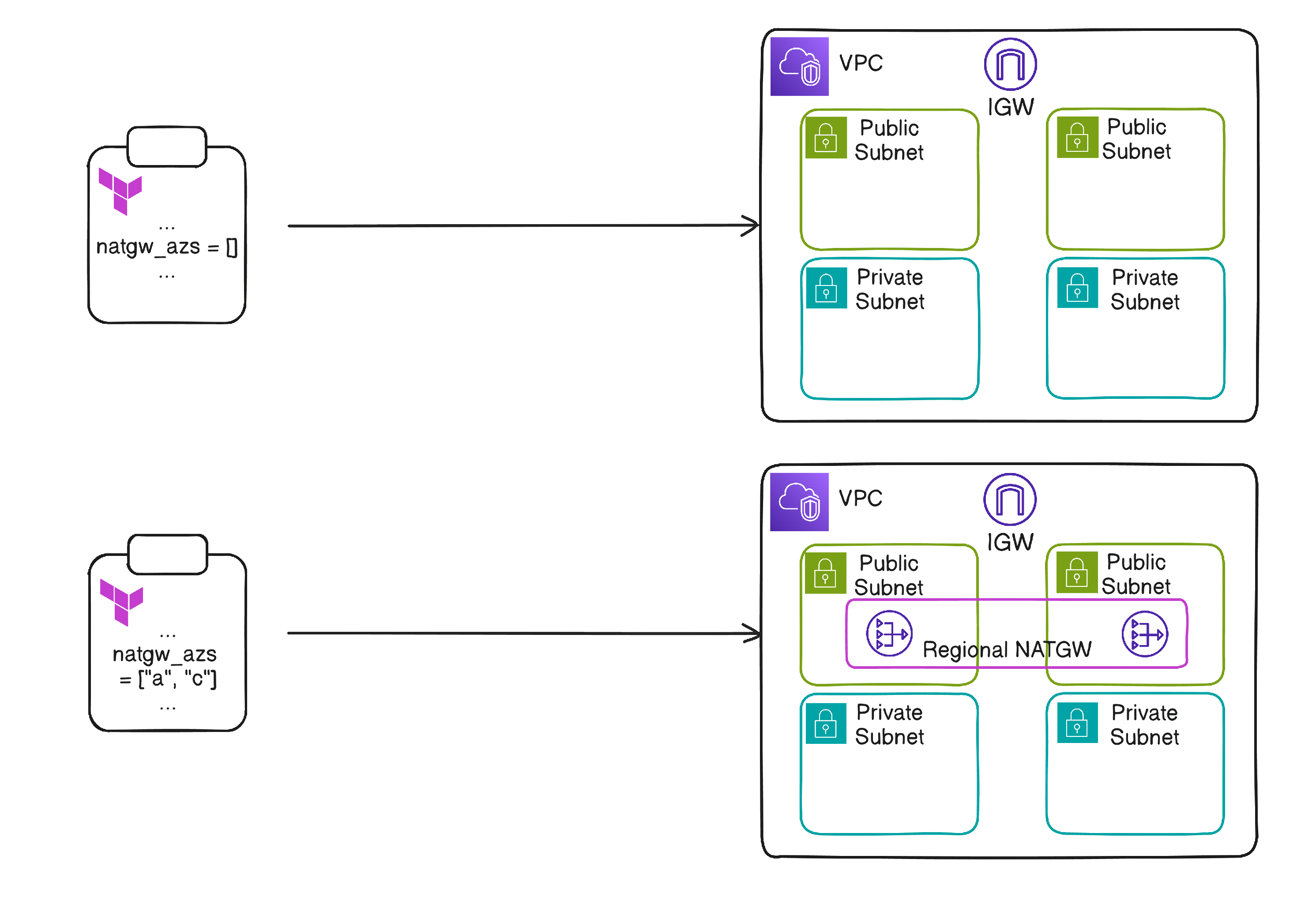
The strategy is to control NAT Gateway provisioning through the natgw_azs variable.
If natgw_azs, which is of type list(string), is empty, Terraform will not create any NAT Gateway or related route table entries.
If those resources already exist, Terraform will remove them during apply.
Based on this behavior, we can build a module that conditionally manages NAT Gateways and routing rules, then integrate it with automation tools to enable costs optimization during non-working hours.
Module
This module creates Regional NAT Gateway when variable natgw_azs has any elements(availability zones).
If natgw_azs is empty, NAT Gateway is desired to be destroyed.
  1
  2
  3
  4
  5
  6
  7
  8
  9
 10
 11
 12
 13
 14
 15
 16
 17
 18
 19
 20
 21
 22
 23
 24
 25
 26
 27
 28
 29
 30
 31
 32
 33
 34
 35
 36
 37
 38
 39
 40
 41
 42
 43
 44
 45
 46
 47
 48
 49
 50
 51
 52
 53
 54
 55
 56
 57
 58
 59
 60
 61
 62
 63
 64
 65
 66
 67
 68
 69
 70
 71
 72
 73
 74
 75
 76
 77
 78
 79
 80
 81
 82
 83
 84
 85
 86
 87
 88
 89
 90
 91
 92
 93
 94
 95
 96
 97
 98
 99
100
101
102
103
104
105
106
107
108
109
110
111
112
113
114
115
116
117
118
119
120
121
122
123
124
125
126
127
128
129
130
131
132
133
134
135
136
137
138
139
140
141
142
143
144
145
146
147
148
149
150
151
152
153
154
155
156
157
158
159
160
161
162
163
164
165
166
| # main.tf
locals {
nat_enabled = length(var.natgw_azs) > 0
}
#########
## VPC ##
#########
resource "aws_vpc" "vpc" {
cidr_block = var.cidr_block
enable_dns_support = true
enable_dns_hostnames = true
tags = {
Name = "${var.cluster_name}-vpc"
}
}
#############
## Subnets ##
#############
resource "aws_subnet" "public" {
for_each = var.public_subnets
vpc_id = aws_vpc.vpc.id
cidr_block = each.value.cidr
availability_zone = var.azs[each.value.az]
map_public_ip_on_launch = false
tags = {
Name = "${var.cluster_name}-public-subnet-${each.key}"
"kubernetes.io/role/elb" = "1"
}
}
resource "aws_subnet" "private" {
for_each = var.private_subnets
vpc_id = aws_vpc.vpc.id
cidr_block = each.value.cidr
availability_zone = var.azs[each.value.az]
map_public_ip_on_launch = false
tags = {
Name = "${var.cluster_name}-private-subnet-${each.key}"
"kubernetes.io/role/internal-elb" = "1"
}
}
resource "aws_subnet" "db" {
for_each = var.db_subnets
vpc_id = aws_vpc.vpc.id
cidr_block = each.value.cidr
availability_zone = var.azs[each.value.az]
map_public_ip_on_launch = false
tags = {
Name = "${var.cluster_name}-db-subnet-${each.key}"
}
}
#################
## IGW & NATGW ##
#################
resource "aws_internet_gateway" "igw" {
vpc_id = aws_vpc.vpc.id
tags = {
Name = "${var.cluster_name}-igw"
}
}
# Create EIPs for each azs
resource "aws_eip" "regional_nat" {
for_each = local.nat_enabled ? toset([
for az in var.natgw_azs : var.azs[az]
]) : []
domain = "vpc"
tags = {
Name = "${var.cluster_name}-regional-nat-${each.key}"
}
}
# NAT Gateway: created when len(natgw_azs) > 0
resource "aws_nat_gateway" "regional_natgw" {
count = local.nat_enabled ? 1 : 0
vpc_id = aws_vpc.vpc.id
availability_mode = "regional"
# Associate EIP alloc & NATGW
dynamic "availability_zone_address" {
for_each = aws_eip.regional_nat
content {
availability_zone = availability_zone_address.key
allocation_ids = [availability_zone_address.value.id]
}
}
tags = {
Name = "${var.cluster_name}-regional-natgw"
}
}
###############################
## Route Table & Association ##
###############################
resource "aws_route_table" "public_rtb" {
vpc_id = aws_vpc.vpc.id
route {
cidr_block = "0.0.0.0/0"
gateway_id = aws_internet_gateway.igw.id
}
tags = {
Name = "${var.cluster_name}-public-rtb"
}
}
resource "aws_route_table" "private_rtb" {
vpc_id = aws_vpc.vpc.id
# Create route entry for NATGW if presents
# aws_nat_gateway.regional_nat returns array, because of `count`
dynamic "route" {
for_each = local.nat_enabled ? [1] : []
content {
cidr_block = "0.0.0.0/0"
nat_gateway_id = aws_nat_gateway.regional_natgw[0].id
}
}
tags = {
Name = "${var.cluster_name}-private-rtb"
}
}
resource "aws_route_table" "db_rtb" {
vpc_id = aws_vpc.vpc.id
tags = {
Name = "${var.cluster_name}-db-rtb"
}
}
resource "aws_route_table_association" "public_rtb" {
for_each = aws_subnet.public
subnet_id = each.value.id
route_table_id = aws_route_table.public_rtb.id
}
resource "aws_route_table_association" "private_rtb" {
for_each = aws_subnet.private
subnet_id = each.value.id
route_table_id = aws_route_table.private_rtb.id
}
resource "aws_route_table_association" "db_rtb" {
for_each = aws_subnet.db
subnet_id = each.value.id
route_table_id = aws_route_table.db_rtb.id
}
|
 1
 2
 3
 4
 5
 6
 7
 8
 9
10
11
12
13
14
15
16
17
18
19
20
21
22
23
24
25
26
27
28
29
30
31
32
33
34
35
36
37
38
39
40
41
42
43
44
| # variables.tf
variable "cluster_name" {
description = "Kubernetes cluster name for prefix"
type = string
}
variable "azs" {
description = "Availability zone aliases"
type = map(string)
}
variable "cidr_block" {
description = "CIDR block for vpc."
type = string
}
variable "public_subnets" {
description = "Public subnets"
type = map(object({
cidr = string
az = string
}))
}
variable "private_subnets" {
description = "Private subnets"
type = map(object({
cidr = string
az = string
}))
}
variable "db_subnets" {
description = "DB subnets"
type = map(object({
cidr = string
az = string
}))
}
variable "natgw_azs" {
description = "EIP alloc az for NATGW"
type = list(string)
}
|
Usage
Here’s the example for using modules.
You can simply toggle NAT Gateway by changing the argument: natgw_azs.
 1
 2
 3
 4
 5
 6
 7
 8
 9
10
11
12
13
14
15
16
17
18
19
20
21
22
23
24
25
26
27
28
29
30
31
32
33
34
35
36
37
38
39
40
41
42
43
44
45
46
47
48
| # main.tf
#######
# VPC #
#######
module "vpc" {
source = "../../../modules/vpc"
cluster_name = var.cluster_name
cidr_block = local.vpc_cidr
azs = {
a = "ap-northeast-2a"
c = "ap-northeast-2c"
}
public_subnets = {
a = {
cidr = "10.1.0.0/24"
az = "a"
}
c = {
cidr = "10.1.1.0/24"
az = "c"
}
}
private_subnets = {
a = {
cidr = "10.1.100.0/24"
az = "a"
}
c = {
cidr = "10.1.101.0/24"
az = "c"
}
}
db_subnets = {
a = {
cidr = "10.1.200.0/24"
az = "a"
}
c = {
cidr = "10.1.201.0/24"
az = "c"
}
}
# When reducing the number of NAT gateway AZs,
# it is safer to first set `natgw_azs` to an empty list and apply,
# then recreate the NAT gateway with the desired AZs.
natgw_azs = ["a", "c"]
}
|
📚 References