💰 Overview
During a capstone design project at school, we had a monthly budget of up to 200,000 KRW.
However, our team had to use EKS, and realistically, that budget was far from enough.
Even after configuring a minimal cluster with only the required database and network components, the estimated monthly cost was around 345 + α USD, where α includes additional network traffic costs and Karpenter Spot instances. (As of 2026.06, based on ap-northeast-2)
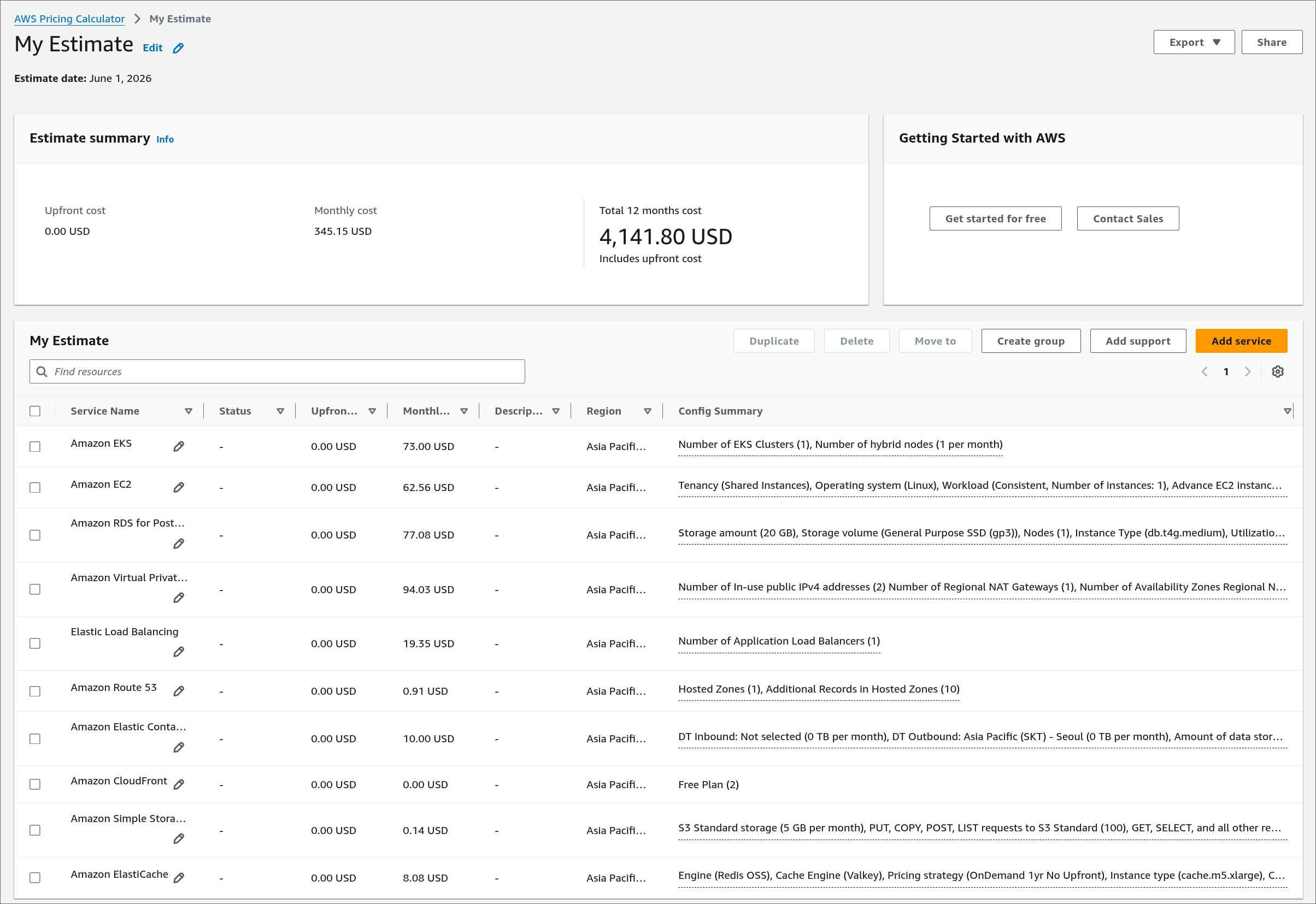
So we had to find a way to reduce cloud costs during the hours when the development environment was not being used.
💡 Cost Optimization Strategy
Initial idea
At first, I considered simply destroying and applying all resources every day with Terraform.
I eventually decided not to use this approach for the following reasons:
- At the time, all resources were declared in a single module, which made the workflow quite cumbersome.
- In particular, if EKS was destroyed, the control plane would be removed and the cluster state would break.
- For example, with Sealed Secrets, the decryption key would be lost and cause problems.
- Since the modules had not been split properly yet, refactoring the structure felt too costly.
- In particular, if EKS was destroyed, the control plane would be removed and the cluster state would break.
- For DB and S3 resources, shutting them down and recreating them could cause more problems.
- Pods inside the cluster might need graceful shutdown handling.
Improved idea
Instead, I chose a strategy that shuts down only some of the resources:
- Scale all Pods inside the cluster to zero with kube-green.
- Stop RDS.
- Run a Lambda function to flush all data from ElastiCache Serverless.
- This was especially important for Valkey, because billing happens in 0.1 GB increments.
- Set the desired node count of the default Managed Node Group to 0.
- This was a very aggressive decision, but it had a major impact on cost reduction. Since off-hour monitoring was not required, removing those nodes was acceptable.
- Separate the NAT Gateway part into its own module and run Terraform only for that part.
- Step Functions runs only that Terraform code through CodeBuild.
- Even when removing only the NAT Gateway, changes to the EIP association, route tables, and related subnet routes come with it, so managing them together through Terraform state was simpler.
- You can check that part here.
I also prepared the following cost-saving strategies for normal operation:
- Use ECR pull-through cache for externally installed containers to minimize NAT Gateway usage.
- This is especially meaningful because the nodes are shut down and brought back up every day.
- Actively use Karpenter + Spot Instances.
- The Managed Node Group desired count is kept at a maximum of 1, and any additional nodes are supplied from Spot Instances.
- Use Graviton nodes, such as
t4g.large.- Since there were no strict CPU architecture constraints, ARM nodes were a good fit.
🔄 Step Functions Implementation
Hibernate
Inside the cluster:
- kube-green scales the deployment replicas down to 0.
Step Function:
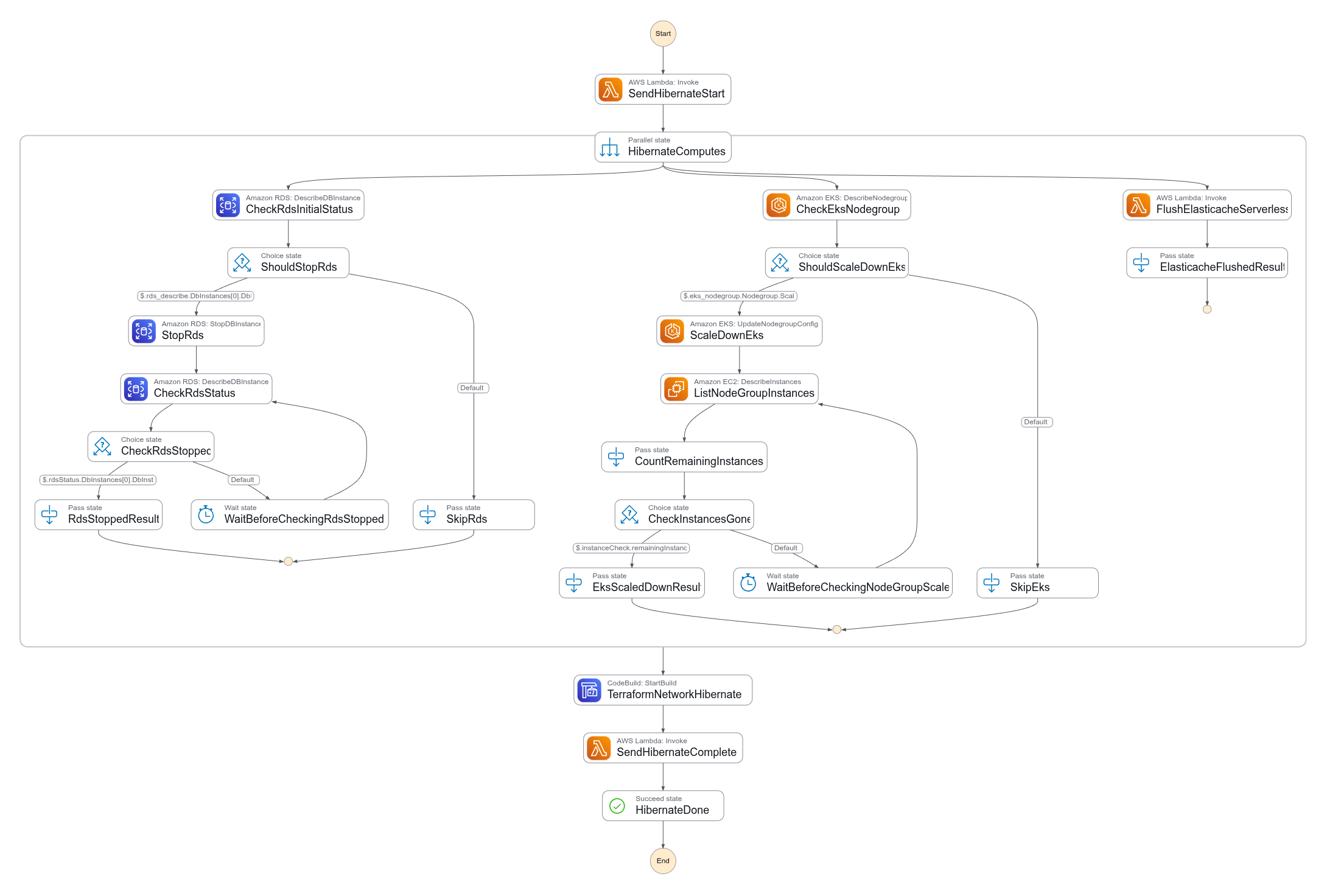
- EventBridge Scheduler starts the hibernate Step Function at the scheduled time.
- The start Lambda sends a Slack notification.
- The following jobs run in parallel:
- MNG zero-scale: Starts a job that sets the desired size of the infra Managed Node Group to 0. It polls EC2/EKS status until the node group instances are actually removed.
- RDS stop: Starts stopping the dev RDS instance. It polls RDS status until the instance reaches the stopped state.
- ElastiCache Serverless: Flushes the cache to reduce unnecessary storage costs.
- After the parallel jobs finish, CodeBuild pulls this repository and applies
live/cluster/vpcagain. - At this point,
hibernate.auto.tfvars.jsonis injected to overridenatgw_azs = []andenable_full_vpce = false, removing the NAT Gateway, its associated EIP, and unnecessary VPC endpoint layers. - The end Lambda sends a Slack notification.
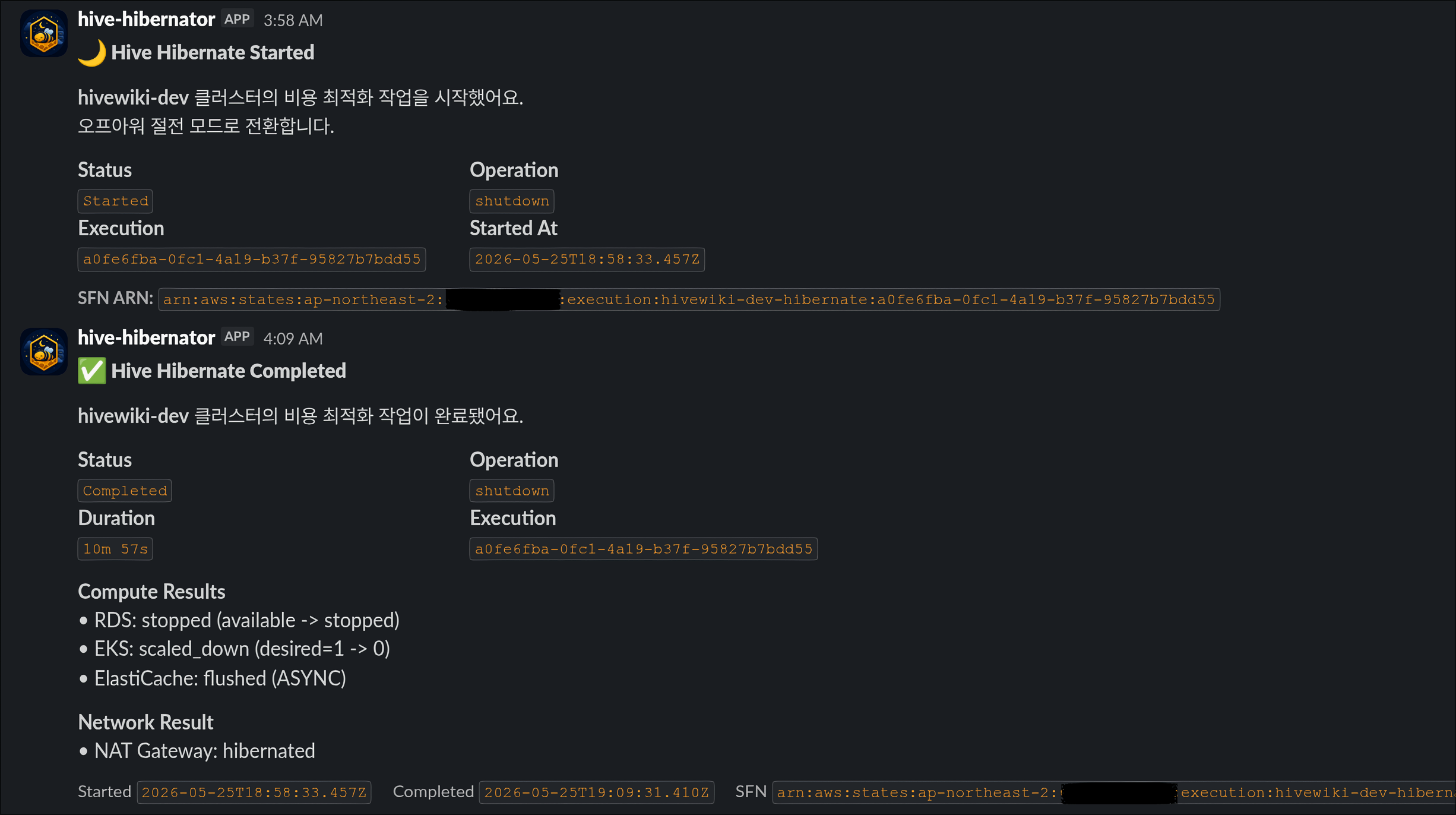
After the workflow finishes, the result of each job and the overall status can be checked from Slack.
Reboot
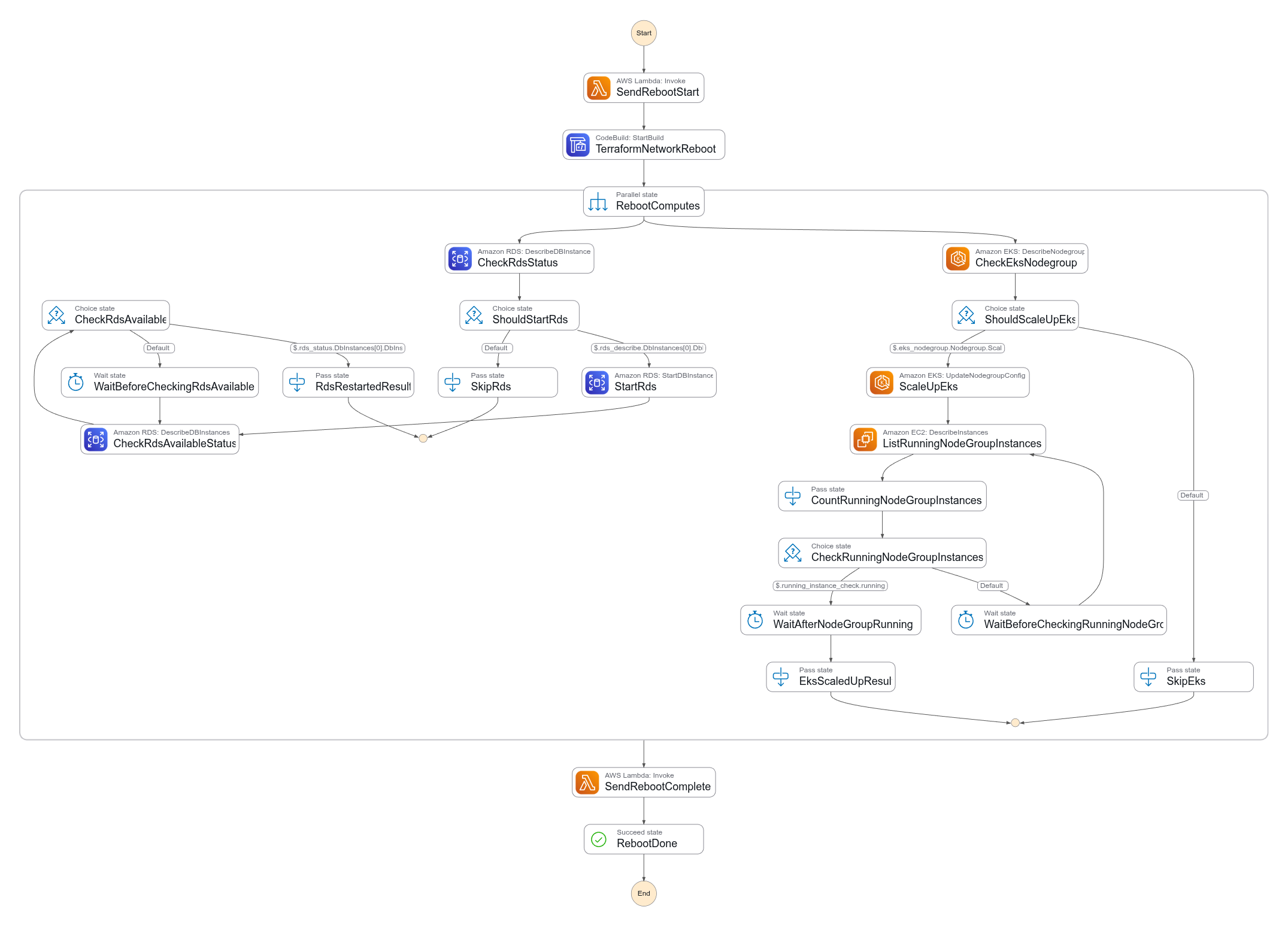
Step Function:
- EventBridge Scheduler starts the reboot Step Function at the scheduled time.
- It applies
live/cluster/vpcagain without injecting temporary variables. - As a result, the NAT Gateway, routing, associated EIP, and required network configuration are restored based on the default values.
- The following jobs run in parallel:
- MNG restore: Restores the desired size of the infra Managed Node Group to its normal operating value. It polls EKS status until scale-up is complete.
- RDS start: Starts the dev RDS instance again. It polls RDS status until the instance becomes available.
- The end Lambda sends a Slack notification.
The reboot workflow also reports the recovery result through a Slack message.
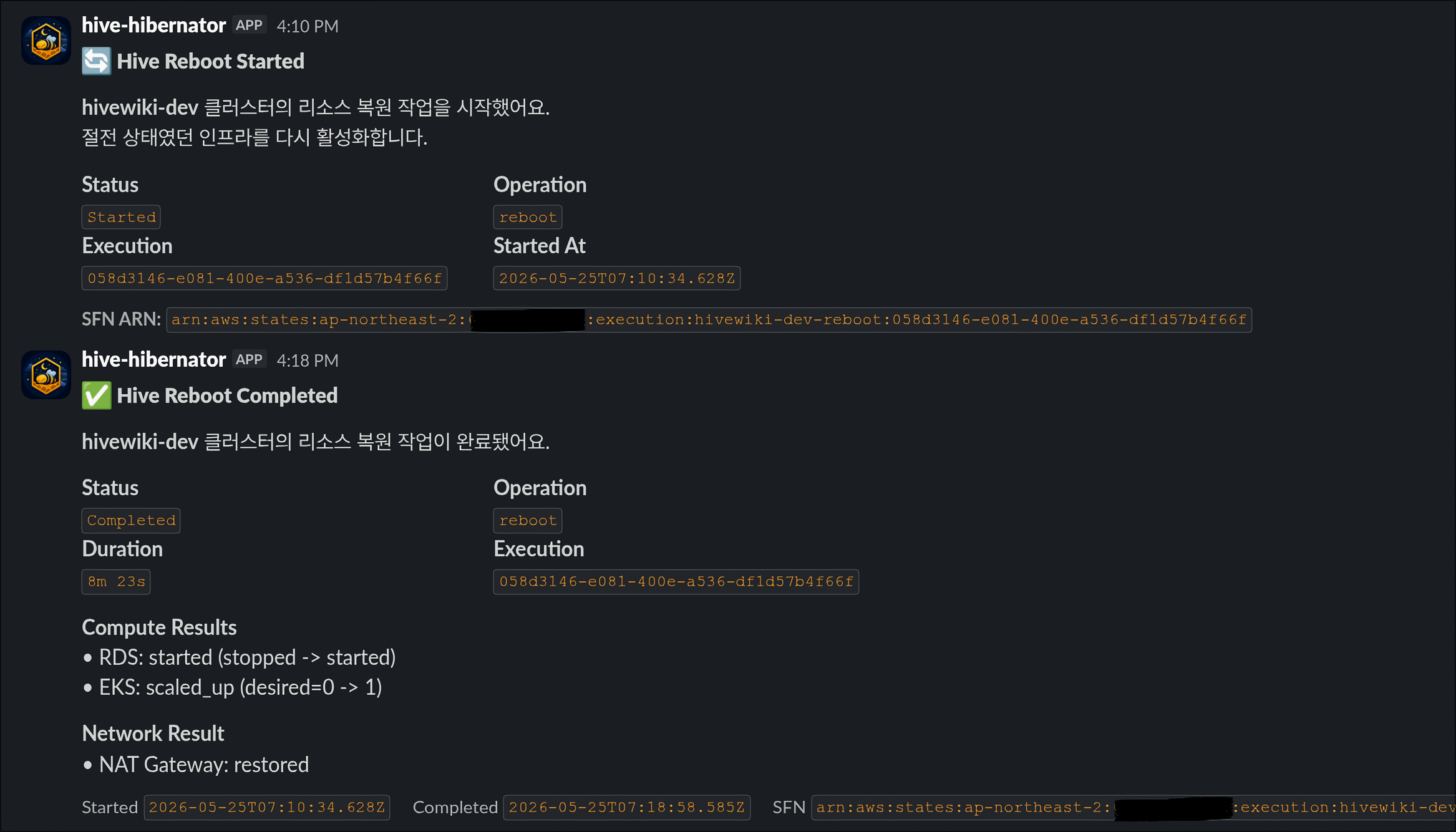
Inside the cluster:
- kube-green restores the Pods.
Code
The full implementation includes Lambda, Step Functions, CodeBuild, and Terraform, so I did not include all of the code in this post.
This post focuses on the cost optimization strategy and execution flow, while the implementation details are available in the links below.
- Step Functions and overall Terraform configuration
- Lambda functions
- CodeBuild buildspec - Hibernate
- CodeBuild buildspec - Reboot
📊 Actual Result
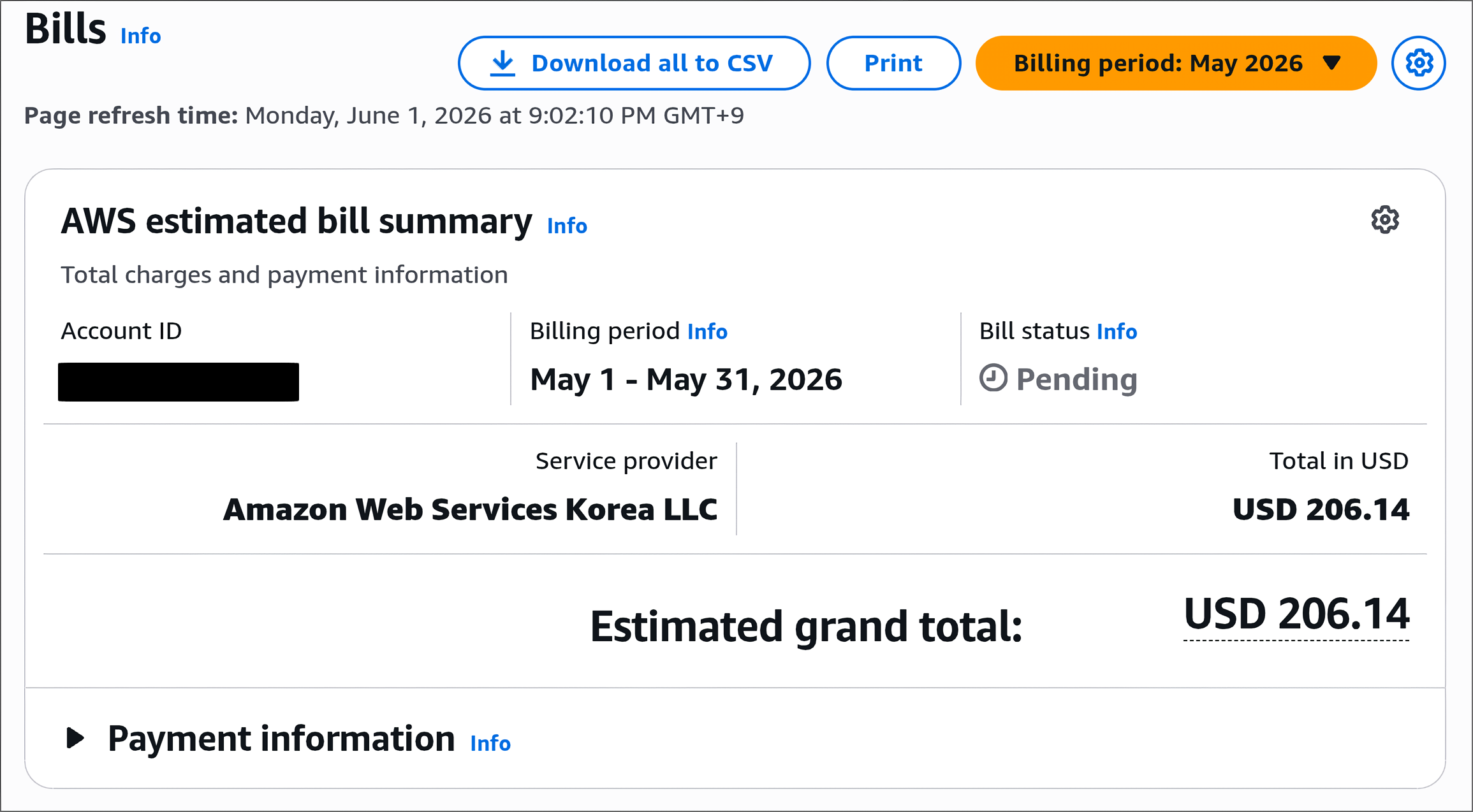
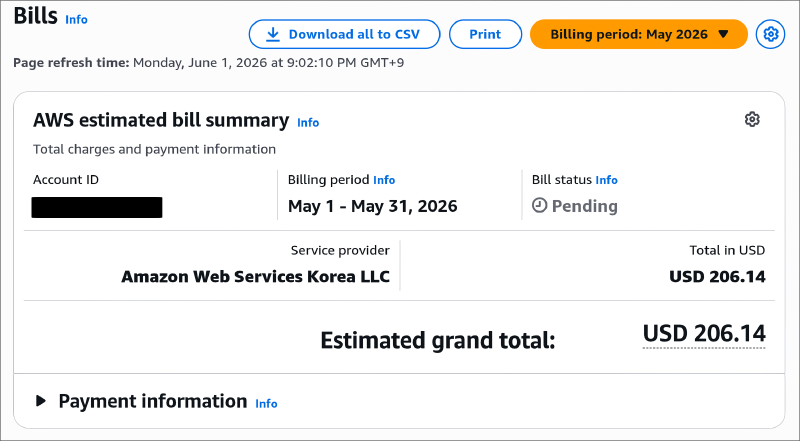
In practice, we reduced the cloud cost for May to 206.14 USD, which means we saved around (40 + α)%.
Since the environment was not started at all for a few days near the end of the month, the realistic saving is closer to around 30-40%.
⚠️ Limitations
This method is not perfect.
The following parts could be improved:
- The coordination between kube-green zero-scaling and Step Functions is quite rough. It simply relies on a schedule gap of 30 minutes.
- The assumption was that 30 minutes after kube-green starts zero-scaling, all Karpenter-managed nodes should have disappeared.
- In practice, this simple 30-minute gap was enough to clean everything up reliably.
- Checking that Managed Node Group instances are back in the Running state is not enough to catch bugs such as kubelet startup failures.
- A better health check would be to query the EKS API from a serverless service and verify that the nodes are actually Ready.
- However, that adds implementation complexity. The current method is simple and still covers most cases well.
- The Lambda functions are not very reusable.
- If I improved this later, I might split the Slack notification logic into a shared component.
- If possible, it might also be worth shutting down Gateway API resources, meaning ELB as well. However, this can conflict with GitOps, and since load balancers are provisioned through Gateway resources, I expected the complexity to be much higher.
In the end, due to project time pressure and the need to keep the implementation simple, I chose the current approach.